
Asset Finance & Alternatives in APAC & Beyond
Aviation Finance, Alt Asset Finance in APAC & Beyond

Your exclusive gateway to the latest developments across transportation and space, and most importantly, how to finance it all - debt, equity, and defi! We follow and forecast where the money’s at.
Join us as we navigate through the latest roundup to uncover key developments across the region.

**Nothing in this article is intended to be or should be construed as legal or financial advice.**
Announcement - APAC AAM Leaders Summit
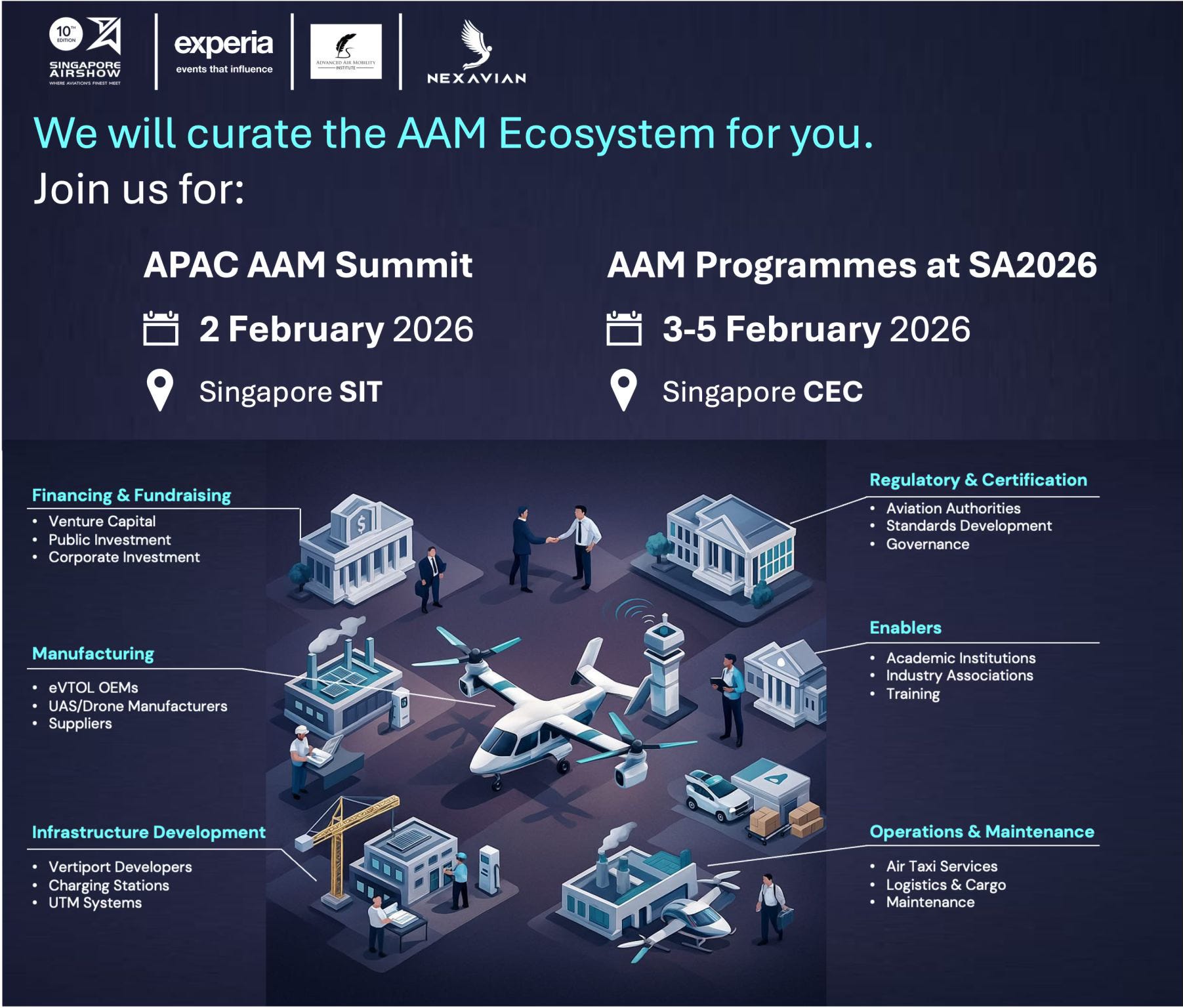
I’m pleased to announce my sponsorship of the APAC AAM Leadership Summit on 2 February at the Singapore Institute of Technology, Punggol Campus.
This exclusive, by-invitation summit, hosted by Singapore’s NexAvian, brings together leaders from aviation, technology, academia, and government to explore the practical rollout of AAM across the Asia-Pacific region.
Discussions will focus on regulatory frameworks, infrastructure development, operational strategies, and lessons from regional markets.
The summit precedes the Singapore Airshow (3–8 February) and offers a unique platform to connect with experts, exchange ideas, and contribute to building a sustainable and efficient AAM ecosystem in Asia.
I am proud to support this important initiative through my companies, Beyond Horizons by Bethel Chambers LLC and LEX.LEXHY.
Looking forward to an inspiring day of dialogue, innovation, and partnership!
Summary
Financing & Investments: Germany’s Congatec Expands R&D Footprint in Malaysia; ACME Group to Build Odisha’s First Green Methanol Plant; Antler Japan Backs Ten Pre-Seed Startups with $1.55M Investment; OpenSys Launches Horizon Series Self-Service Banking Platform; Decube Raises $3M to Scale AI Data Solutions in APAC; STT GDC Unveils Southeast Asia’s First HVDC AI Testbed; HeyMax Secures $11M Series A to Expand Loyalty Platform Across Asia; Digital Edge Commits $4.5B to Build Indonesia’s CGK AI Data Center; and Micron Technology to Invest $24B in Singapore Wafer Fab Expansion
Environmental Sustainability: UK-China Launch Renewable Energy Trading JV; Sinopec Demonstrates Long-Distance Hydrogen Logistics; China-India Nearshore Wind Turbines to Power Vietnam; India Rolls Out Lithium Battery Recycling Subsidiary; and FedEx Expands Electric Delivery Fleet in Japan
Aviation: China Proposes Rules for Airline Seat Allocation; Global Air Passenger Traffic Forecast to Hit 10.2 Billion in 2026; Hong Kong-France JV Targets Aircraft Dismantling and Parts Trading; India’s Turboprop Market Set for Major Regional Expansion; Singapore Extends Aircraft Nacelle MRO Partnership; and Boeing Projects Rapid Fleet Growth in South Asia
Advanced Air Mobility: China, Spain Partner on Pilotless eVTOL Mobility; China’s TCab Tech Prepares Five-Seater eVTOL for APAC Deployment; Delhi Could See 40M Air Taxi Trips Annually by 2045; and US Firm Pushes India to Designate Safety-Critical Spectrum for AAM
Marine: Australia’s Strategic Fleet Program Faces Delays; Japan Forms JV to Boost Domestic Shipbuilding; Shadow Tanker Network Exposed Supplying Myanmar Air Force; Singapore Firm Invests in Charter-Backed Multipurpose Vessels; and PSA and MOL Create Dedicated Roro Terminal in Singapore
Space: China’s CASC Expands Into Commercial Space Sectors; China Launches AlSat-3B Remote Sensing Satellite; Indonesia’s Nusantara Lima Satellite Reaches Geostationary Orbit; South Korea Deploys NEONSAT‑1A for Earth Observation; and US-Australia Varda Space Completes W-5 Capsule Reentry
Financing & Investments
The region continues to attract investment in advanced technology, green energy, and AI-driven infrastructure. Trends include local expansion of R&D and engineering, development of sustainable energy and industrial solutions, and scaling of next-generation digital and data center platforms to meet growing demand for AI, cloud, and high-performance computing.
Germany-Malaysia
Germany-based congatec has opened a new subsidiary in Penang, Malaysia, expanding its engineering and R&D presence in Asia. The move supports the company’s “local for local” strategy, establishing regional capabilities in embedded computing design, technical support, and customization. The initial team of 23 engineers, recruited from Kontron Asia, will grow to around 70, strengthening the firm’s ability to deliver application-ready solutions and faster development cycles for customers across the APAC region.
💡The Penang subsidiary will focus on embedded computing platforms, including x86-based systems and Computer-on-Modules using Qualcomm, NXP, and Texas Instruments technologies, alongside enhanced aReady. software stacks.
India
Indian conglomerate ACME Group plans to establish a 200-tonne green methanol production plant in Kendrapada district, Odisha, through its subsidiary ACME Akaysha Energy. The facility will be the state’s first large-scale green methanol plant and is expected to generate over 1,100 jobs, supporting India’s push to become a global hub for green hydrogen and its derivatives.
💡The project forms part of ACME’s broader strategy to develop multiple green hydrogen and ammonia plants near Paradip and Gopalpur, with production aimed at both domestic use and export. ACME highlighted Odisha’s strong green energy ecosystem and industrial infrastructure as key factors in its selection of the site.
Japan
Antler Japan, the Japanese arm of Singapore-based venture firm Antler, invested ¥240 million ($1.55 million) across ten pre-seed startups in 2025, backing founders deliberately building for global markets. Each company received ¥24 million via Antler’s Inception Residency, which supports early validation, strategy, and investor readiness. Startups span AI, robotics, logistics, compliance, and applied science, including Refined Robotics, Avete, and Rubi Labs.
💡For 2026, Antler Japan launches a streamlined six-week Inception Residency with $150,000 initial investment and up to $250,000 follow-on funding. The program prioritizes speed, international collaboration, and early market traction. The next cohort begins May 11, with an Investor Demo Day on February 13 to connect founders with regional investors.
Malaysia
Malaysia-based OpenSys (M) Berhad has launched the Horizon Series, a next-generation self-service banking platform developed with OKI Electric through its subsidiary OpenSys Technologies. The locally assembled system features cash recycling, allowing deposited cash to be reused for withdrawals, reducing idle holdings, replenishment frequency, and operational costs while consolidating multiple self-service functions into a single device for more efficient branch operations.
💡Horizon Series is modular and upgradeable, supporting cheque deposits, instant card issuance, digital services, and biometric authentication, with AI-enabled and remote assistance capabilities. Security and regulatory compliance are built into both hardware and software. The platform will be commercially available from January 2026.
Malaysia
Malaysia-based Decube has raised $3 million in a round led by Taiwania Hive Ventures, with participation from Iterative and 500 Global. The funding will support the company’s global growth, product innovation, and rapid expansion across the Asia-Pacific region as enterprises increasingly seek trusted data for AI at scale.
💡Decube provides a context layer between raw data systems and AI applications, enabling enterprises to track data lineage, ownership, and quality while ensuring production-ready, explainable inputs. Already deployed across banks, telcos, and regulated corporates, the platform helps organizations operationalize AI responsibly and move from experimentation to scalable, enterprise-grade solutions.
Singapore
ST Telemedia Global Data Centers (STT GDC) has launched the FutureGrid Accelerator, Southeast Asia’s first live High Voltage Direct Current (HVDC) AI infrastructure testbed, in collaboration with LITEON, NTU’s Energy Research Institute, and NTU spinoff Amperesand.
Located at NTU Singapore’s Electrification and Power Grids Center on Jurong Island, the initiative integrates HVDC with real AI workloads, enabling ultra-high-density computing while improving energy efficiency, reducing carbon emissions, and supporting renewable power integration. The testbed validates power loads of at least 325kW and combines LITEON’s reference architecture with Amperesand’s Solid State Transformer technology.
💡The FutureGrid Accelerator aims to advance sustainable, next-generation AI data centers while building regional expertise in digital and energy infrastructure. STT GDC plans to scale HVDC adoption across future operations, enhancing resilience, reliability, and operational efficiency. The project also provides training opportunities for emerging talent and strengthens collaboration between industry, academia, and deep-tech startups.
Singapore
Singapore-based loyalty and travel rewards platform HeyMax has raised $11 million in a Series A round led by Peak XV Partners, with participation from strategic investor Betatron Venture Group and continued support from existing backers January Capital and Tenity. Additional investors include Agoda co-founder Rob Rosenstein and former Visa APAC President David Lee. The funding will accelerate HeyMax’s AI-powered platform, enhancing seamless earning and redemption of rewards while supporting expansion into Japan, Taiwan, and Australia by the end of 2026.
💡Founded in 2023, HeyMax unifies travel and loyalty rewards across airlines, hotels, and financial products through its Max Miles currency. The platform addresses fragmented loyalty programs in Asia-Pacific, helping consumers capture cross-border value and enabling merchants to drive engagement. Since its $2.7 million seed round in 2024, HeyMax has grown to over 150,000 users, issued more than 500 million Max Miles annually.
Singapore-Indonesia
Singapore-based Digital Edge is investing $4.5 billion to build CGK Campus, one of Indonesia’s largest AI-ready hyperscale data center campuses, in Bekasi’s GIIC Industrial Estate. The 500MW facility, scalable up to 1GW, is engineered for next-generation AI workloads with sustainability features including liquid cooling, recycled water, and renewable energy integration, targeting a market-leading PUE of 1.25.
💡CGK Campus will be carrier-neutral and connected via Digital Edge’s Indonet fiber network, offering low-latency access to Jakarta’s business districts. Built in phases starting Q4 2026, the campus aims to support Indonesia’s expanding digital economy and serve as a central hub for hyperscale, AI, and cloud deployments across the region.
USA-Singapore
US semiconductor firm Micron Technology will invest $24 billion over ten years to build an advanced wafer fabrication facility in Singapore, adding 700,000 square feet of cleanroom space within its existing NAND complex. Production is expected to start in the second half of 2028, supporting growing demand for AI and data-driven applications, while creating 1,600 jobs in fab engineering, operations, and smart manufacturing.
💡Alongside its HBM packaging facility, the expansion will bring Micron’s total Singapore workforce growth to about 3,000. The site will follow sustainability standards, including LEED compliance, and collaborate with academia to upskill talent and accelerate AI-enabled semiconductor innovation.
Environmental Sustainability
The region is rapidly advancing clean energy and circular economy initiatives, with trends in cross-border renewable trading, scalable hydrogen logistics, large-scale wind projects, battery recycling, and electrification of transport. Investment focus is shifting toward integrated sustainability solutions that combine technology, infrastructure, and industrial ecosystems to reduce emissions and close energy and material loops.
Britian-China
British energy company Octopus Energy Group has partnered with China’s PCG Power to form a joint venture, Bitong Energy, aimed at trading renewable electricity in China’s growing spot markets. The JV, launched during UK Prime Minister Keir Starmer’s visit to China, will initially operate in Guangdong before expanding nationwide, targeting up to 140 TWh of renewable electricity annually by 2030.
Bitong Energy combines Octopus Energy’s trading technology and optimisation software with PCG Power’s local market expertise. The venture is expected to achieve a valuation of over GBP 500 million within five years and generate around GBP 50 million in annual profits, positioning it as a major player in China’s clean energy market.
China
Sinopec has completed a new long-distance hydrogen logistics demonstration in China, with three hydrogen-powered trucks traveling about 1,500 km from Shanghai to Yichang along the Yangtze River. The vehicles crossed five provinces and municipalities and refueled at six Sinopec hydrogen stations en route, showing that cross-regional hydrogen transport is becoming operationally viable.
The run builds on earlier intercity hydrogen corridors and links Sinopec’s eastern and central China networks, supporting wider deployment of fuel-cell vehicles on major highway routes.
💡The company now operates 11 hydrogen supply centers and 146 hydrogen refueling stations across China, covering all national fuel-cell pilot city clusters. Sinopec also reports hydrogen production capacity of more than 4.4 million tonnes per year and is developing large renewable hydrogen projects and long-distance hydrogen pipelines. Together, the logistics trials and infrastructure build-out are aimed at enabling commercial hydrogen transport, lowering emissions in freight, and accelerating hydrogen mobility across key economic regions.
China-India
China’s Envision Energy has secured a contract to supply 128 MW of nearshore wind turbines for projects in Vietnam’s Vinh Long province. The order, placed by Vietnam’s REE Group, covers two developments—48 MW V1-3 Phase II and 80 MW V1-5&6 Phase II—using 16 EN-226/8.X MW turbines, each with a 226-metre rotor, making them among the largest nearshore wind turbines in Southeast Asia. Construction is scheduled to start soon, with grid connection targeted for October 2026.
💡The turbines are built to offshore standards to withstand humidity and salt spray, with an expected operational life of over 20 years. Envision is collaborating with local Vietnamese tower manufacturers to manage the challenges of producing large offshore components. Since its 2022 launch, the EN-226/8.X MW platform has accumulated over 2.5 GW in orders and has been deployed in offshore projects in China.
India
💡India-based lithium battery manufacturer Maxvolt Energy Industries has launched a wholly owned subsidiary, Maxvolt ReEarth, focused on integrated lithium battery recycling. The unit will handle second-life battery applications, dismantling and recycling of end-of-life batteries, production of black mass, and recovery of critical minerals such as lithium, nickel, cobalt, and manganese using mechanical processing, hydrometallurgical extraction, and direct lithium recycling technologies.
Maxvolt ReEarth plans to collaborate with EV manufacturers, fleet operators, battery producers, telcos, energy storage providers, government agencies, PSUs, and R&D institutions to strengthen supply and close the loop in India’s lithium battery value chain.
Japan
FedEx has expanded its zero-emissions delivery fleet in Japan with the deployment of 17 electric trucks across Tokyo, Kanagawa and Osaka. The vehicles, including Mitsubishi Fuso eCanter and Isuzu ELF EV models with payloads of about 1.5 tonnes, will be used for parcel pickup and last-mile delivery in dense urban areas. FedEx estimates each truck will cut around 3.3 tonnes of tailpipe CO₂ emissions per year compared with diesel equivalents, supporting cleaner city logistics.
💡The rollout is part of FedEx’s wider plan to electrify its pickup and delivery operations and reach carbon-neutral operations by 2040.
Aviation
Aviation trends show strong growth in passenger traffic, regional connectivity, and sustainable operations, driven by rising demand, short-haul efficiency, and infrastructure upgrades. Key patterns include investment in aircraft lifecycle management, predictive maintenance, circular supply chains, and scalable fleet expansion to support long-term economic and environmental goals.
China
The China Air Transport Association (CATA) has released draft rules to regulate airline seat reservation practices, standardize air transport procedures, and safeguard passengers’ rights. Open for public comment until February 27, the rules introduce limits on the proportion of “blocked seats” and define principles for accessing and releasing them. Economy class seating must include at least 70 percent free selectable seats on domestic flights and 65 percent on international or regional flights, ensuring passengers who purchase tickets closer to departure have fair access to quality seating.
💡The draft also restricts cash-based paid seat selection on domestic flights, allowing only frequent flyer members to redeem points or tier benefits for specific seats. Paid selection remains permitted on international and regional flights, with airlines responsible for managing seat allocation based on demand.
Global
Airports Council International (ACI) World projects global passenger traffic will reach 10.2 billion in 2026, up 3.9 percent from 2025, and expects long-term demand to double by 2045 to 18.8 billion, growing at a 3.4 percent annual rate. The forecast notes that growth will be uneven across regions, driven by emerging markets, and constrained by airport capacity, aircraft delivery challenges, and operational complexities.
💡ACI World emphasized that meeting this demand will require coordinated industry action. Director General Justin Erbacci urged accelerated investment in airport infrastructure, airspace capacity, and operational resilience, warning that insufficient preparation could create bottlenecks, reduce service quality, and limit aviation’s contribution to the global economy, which currently accounts for 3.9 percent of GDP.
Hong Kong-France
Hong Kong’s China Aircraft Services (CASL) and France-based Elior Group have formed a 50-50 joint venture focused on aircraft dismantling and trading in aircraft parts. The collaboration aims to create a closed-loop aviation ecosystem in Hong Kong, covering maintenance, parts recycling, certification, and trading. Executives say the initiative will strengthen Hong Kong’s role in the global aviation supply chain, create jobs in aviation and related sectors, and support the city’s development as a regional aviation hub.
💡Retired aircraft will be brought to CASL’s hangars for evaluation, then transported to a dedicated facility near Hong Kong International Airport for dismantling and parts trading. The joint venture is designed to serve a market currently reliant on Europe and the U.S. for aircraft recycling, and the partners aim to begin operations before the end of the year.
India
Regional aircraft maker ATR has highlighted India’s short-haul connectivity as a turboprop-driven market in a new white paper. Analyzing 4.6 billion annual inter-city journeys, ATR found that over 90% are under 400 nautical miles, the range where turboprops outperform regional jets on cost, fuel efficiency, and sustainability. The study projects India will need 210 new turboprops by 2044 to support regional expansion, with up to 900 new domestic routes—420 of which fall squarely within turboprop territory—and 35 million additional passengers anticipated through UDAN-backed airport growth.
The report emphasizes the economics of turboprops for India’s price-sensitive market, noting 45% lower fuel burn and emissions compared with regional jets, right-sized capacity for Tier 2 and 3 city demand, and resilience amid rising fuel costs. With the expansion of 85 additional airports, ATR projects air travel could rise from 150 million to 240 million passengers annually, as regional turboprops unlock underserved markets and provide sustainable, affordable connectivity to millions currently dependent on road and rail.
Singapore
ST Engineering’s Commercial Aerospace business has extended its nacelle maintenance, repair, and overhaul (MRO) partnership with LOT Polish Airlines for five years, supporting the airline’s 15 Boeing 787 Dreamliners.
💡The agreement introduces a structured refurbishment programme that embeds predictive maintenance into nacelle lifecycle management, aiming to reduce unscheduled removals, improve turnaround performance, and optimize total cost of ownership while strengthening operational resilience.
South Asia
Boeing projects passenger air traffic in India and South Asia to grow at an average of 7 percent annually over the next 20 years, driven by a rising middle class, economic growth, and airport and connectivity investments. Airlines in the region will require nearly 3,300 new airplanes by 2044, with single-aisle jets making up nearly 90 percent of deliveries to serve fast-growing short- and medium-haul routes. The regional fleet is expected to expand from 795 to 2,925 aircraft, supported by increased domestic travel and a continued shift from rail to air.
💡The outlook also anticipates rapid expansion of long-haul and cargo operations. Widebody fleets are projected to more than triple, while freighter aircraft will grow fivefold to meet rising e-commerce and manufacturing demand. To support this growth, the region will need over $195 billion in aviation services and roughly 141,000 new professionals, including pilots, technicians, and cabin crew, to operate and maintain the expanding fleet.
Advanced Air Mobility
Urban air mobility is accelerating, with eVTOL development, infrastructure planning, and regulatory frameworks advancing across Asia and beyond. Trends include public-private collaboration, large-scale fleet and vertipad projections, and efforts to secure spectrum and safety standards for safe, scalable low-altitude air transport.
China
EHang has signed a Memorandum of Understanding with Spain’s Real Automóvil Club de España (RACE) to collaborate on advanced air mobility and next-generation mobility solutions. The partnership leverages RACE’s expertise in motorsport, safety, and high-performance operations alongside EHang’s pilotless eVTOL technology to conduct demonstration flights, ecosystem development, and public engagement activities.
💡The MoU includes controlled validation flights at Madrid Jarama – RACE Circuit and joint work on regulatory and safety standards for AAM. The collaboration also promotes public education on sustainable mobility and supports Madrid’s ambition to become a global hub for innovative transport solutions.
China
Shanghai-based eVTOL developer TCab Tech will showcase its five-seater E20 aircraft at the APAC AAM Summit during the Singapore Airshow. Founded in 2021, the company has completed full-scale E20 transition tests and is now refining systems and generating certification evidence ahead of a 2027 type-certification target. The aircraft is designed for sightseeing, short-range shuttles, cargo, and special missions, with redundant flight-control systems, battery safety measures, and integrated propulsion architectures supporting regulatory approval and operational reliability.
💡TCab Tech is also advancing global deployment partnerships, including a 100-aircraft intent order with Abu Dhabi’s Autocraft and its Air Silk Road Global Pioneer initiative. The company emphasizes building trust through disciplined flight testing, certification alignment, and standardized operational playbooks, enabling partners to scale AAM services safely and efficiently across Southeast Asia, the Middle East, and other emerging low-altitude markets.
India
Australian firm Skyportz forecasts Delhi could see 40 million air taxi trips annually by 2045, with demand for roughly 2,200 vertipads in the city and 10,000–15,000 across India. The projections, shared during Wings India, highlight potential annual passenger revenues of US$400 million in Delhi and up to US$2.5 billion nationwide, driven by long commutes, slow peak-hour traffic, and growing adoption of urban air mobility.
💡Part of Skyportz’s five-city “frontier” study, the analysis emphasizes that infrastructure rollout will depend on regulation, technology performance, and investment trends. Falling costs and distributed vertipad deployment could make air taxis a viable, competitive alternative to traditional road transport.
US-India
American satellite communications firm Viasat is urging Indian authorities to designate the L‑band (1–2 GHz) as safety‑critical spectrum for advanced air mobility operations. The company says L‑band, already used for mobile satellite services, provides reliable connectivity for command, control, navigation, and data links critical to beyond-visual-line-of-sight (BVLoS) aircraft.
💡Viasat has engaged with the Department of Telecommunications (DoT) and the Wireless Planning and Coordination (WPC) Wing to secure regulatory clarity and spectrum allocation for safety‑critical AAM communications.Viasat highlighted the need for coordination with the Directorate General of Civil Aviation (DGCA) to ensure crewed and uncrewed aircraft coexist safely in Indian airspace.
Marine
Maritime initiatives reveal a focus on national resilience, domestic shipbuilding, and commercial innovation, alongside emerging security risks from opaque fuel supply chains. Trends include integrating investment with long-term charters, strengthening local maritime ecosystems, and ensuring reliable, high-value shipping capacity amid growing regional trade and defense needs.
Australia
Australia’s proposed strategic fleet of Australian-flagged ships has slipped behind schedule, with the government yet to announce winners for the first three vessels promised under its pilot program. The scheme is meant to keep a small pool of commercially operated ships crewed by Australians that could be called on in emergencies or defence situations, with government payments helping offset higher local operating costs. Canberra has allocated A$21.7m over five years, but the delay comes as Australia relies almost entirely on foreign-flagged tonnage, with only a handful of locally crewed commercial ships still trading.
Industry and security specialists warn the pause exposes wider vulnerabilities. Maritime groups say the fleet is needed both to rebuild the domestic seafarer base and to ensure access to shipping during crises, while analysts argue Australia’s trade and energy security depend heavily on uninterrupted sea transport. Although the pilot is seen as a useful first step, critics say it is modest compared with the scale of Australia’s dependence on global shipping and should be part of a broader strategy linking defence, trade and workforce development.
Japan
Japan has launched a new domestic shipping initiative aimed at securing work for its shipyards and strengthening the local maritime value chain amid rising competition from China and South Korea. ORIX’s vessel trading arm SOMEC has partnered with three major Japanese owner-builder groups—Shoei Kisen, Kambara Kisen, and Onomichi Dockyard—to form a joint venture shipowner, Sakura Ocean Corporation.
The JV plans to order three new vessels, one from each shipyard, for delivery by 2030 and charter them to Japanese operators. Ownership of Sakura Ocean will be split 30% each among the three shipyards, with SOMEC holding 10%, while Santoku Senpaku, an ORIX subsidiary, will oversee technical management.
💡The initiative represents Japan’s first integrated approach combining shipowners, builders, and traders in a single platform, aimed at stabilizing domestic orders, keeping ship finance onshore, and strengthening Japan’s influence in next-generation shipping.
Myanmar
A new Amnesty International investigation has revealed a shadow tanker network supplying Myanmar’s air force with jet fuel, raising concerns over civilian attacks. The report identifies at least nine aviation fuel shipments between mid-2024 and the end of 2025, delivered by four tankers using “shadow fleet” tactics, including turning off AIS tracking, spoofing positions, and opaque ship-to-ship transfers. Myanmar imported over 109,600 tonnes of aviation fuel in 2025, a 69% increase from the previous year, despite Western sanctions targeting its fuel supply.
Four vessels—Huitong 78 (Baraawe 1), Yong Sheng 56 (LS Mercury), Reef (ex-Baltic Horizon), and Noble (ex-Astra)—were central to these operations, frequently operating from offshore hubs such as the Fujairah Offshore Anchorage Area. Amnesty’s analysis and satellite imagery suggest that Reef and Noble were carrying Iranian fuel, using tactics similar to other sanctioned fuel networks.
💡The NGO warns that Myanmar’s jet fuel supply chain is increasingly opaque and has “gone rogue,” enabling the military to continue airstrikes on civilians despite international restrictions.
Singapore-Denmark
Singapore-based Wealth Holdings is entering the multipurpose vessel market with a charter-backed newbuilding programme of up to eight ships. The company has secured four firm 17,400-dwt MPPs with two plus two options, with Denmark’s DS Norden providing time-charter cover. Wealth Holdings Shipping will own the vessels and provide the capital, while Norden will handle commercial operations and trading.
The ships will be built at China’s Jiangsu Haitong Shipyard, with prices undisclosed. The structure reflects a broader project cargo trend of pairing asset investment with long-term chartering to improve earnings visibility in a tight market.
💡Designed for project and energy cargoes such as wind components and heavy industrial units, the vessels will feature an accommodation-forward layout with flexible deck space. For Wealth Holdings, which has previously operated only a small bulker fleet, the order marks a move into higher-value trades backed by Norden’s global platform. For Norden, the deal supports its growing charter-backed model, following more than 20 lease agreements in 2025, around half of them in the multipurpose segment.
Singapore-Japan
PSA Singapore and Mitsui OSK Lines (MOL) are set to create a joint venture to operate a dedicated roro terminal in Singapore, subject to regulatory approval. The facility is expected to begin operations in the first half of 2026 and will support MOL’s growing car carrier business while expanding PSA’s role in vehicle handling at the port. The move aims to ensure reliable service, increase operational efficiency, and secure long-term terminal capacity in one of Asia’s largest automotive transshipment hubs.
💡MOL will contribute its international roro network and automotive client base, while PSA will provide port infrastructure and expertise in terminal operations. Both companies plan to jointly manage the terminal and collaborate on digital solutions, workflow optimisation, and sustainability initiatives.
Space
Space activity in the region is rapidly expanding, with trends in commercial space development, advanced satellite deployment, and end-to-end mission operations. Focus areas include Earth observation, high-throughput connectivity, space tourism, resource exploration, and responsive orbital operations, signaling growing strategic, economic, and technological ambitions in the sector.
China
The China Aerospace Science and Technology Corporation (CASC), plans to expand into commercial space sectors including space tourism, digital infrastructure, resource development, and space traffic management, according to state media reports.
The announcement aligns with China’s forthcoming 15th Five-Year Plan (2026–2030) and highlights long-term ambitions such as asteroid exploration, cislunar infrastructure, and space-based gigawatt-scale computing, while also proposing autonomous satellite operations, optical inter-satellite links, and on-orbit data processing. CASC envisions integrating space systems into broader economic and strategic priorities under its “space+” concept.
💡The corporation also outlined plans for suborbital and orbital space tourism vehicles, reusable heavy-lift launchers capable of delivering 20- to 100-ton payloads to low Earth orbit, and new commercial launch infrastructure in Jiuquan, Hainan, and eastern coastal areas. CASC aims to strengthen space traffic management with debris monitoring, early warning systems, and removal technologies, potentially positioning China to influence international rules for orbital safety.
China-Algeria
China successfully launched the AlSat-3B remote sensing satellite from the Jiuquan Satellite Launch Center on Saturday. Carried by a Long March-2C rocket, the satellite was placed into its designated orbit at 12:01 p.m. Beijing time. AlSat-3B, developed by the China Academy of Space Technology under CASC, will support applications including land planning and disaster prevention.
💡The mission is part of Algeria’s remote sensing satellite program, a collaboration between China Great Wall Industry Corporation and the Algerian Space Agency. It follows the recent launch of AlSat-3A on January 15 and is supported by associated ground systems, training, and services. This launch marked the 629th flight of China’s Long March rocket series.
Indonesia
Nusantara Lima Satellite (SNL), also known as Satellite N5, has successfully reached its designated geostationary orbit above Kalimantan, completing its Electric Orbit Raising phase. Launched aboard SpaceX’s Falcon 9 in September 2025, the satellite now occupies the 113-degree east longitude position, around 35,786 kilometers above Earth, and is set to enter a three-month testing and verification period before full operations begin in April 2026.
💡Owned by PT Pasifik Satelit Nusantara (PSN), SNL is a Very High Throughput Satellite with over 160 Gbps capacity, featuring 101 Ka-band spot beams covering Indonesia. The satellite will expand internet access, support public services, economic development, environmental monitoring, and defense, and, together with PSN’s ground network, will bring Indonesia’s total satellite capacity to more than 400 Gbps—the largest in the Asia-Pacific region.
South Korea
South Korea has successfully deployed its NEONSAT‑1A satellite into low Earth orbit as part of its plan to build an advanced Earth-observation constellation. Launched aboard Rocket Lab’s 81st Electron rocket from Launch Complex 1 in New Zealand on January 30, the satellite will test capabilities for monitoring natural disasters and national security events along the Korean Peninsula. NEONSAT‑1A follows the 2024 deployment of NEONSAT‑1, the first in the government’s planned constellation.
💡The mission, named “Bridging The Swarm,” marks Rocket Lab’s second launch in just eight days and its second mission of 2026, demonstrating growing demand for responsive satellite deployment.
US-Australia
Varda Space Industries successfully completed the reentry of its W-5 capsule, the first mission using its in-house satellite bus. Launched in November 2025, W-5 carried a U.S. Navy payload and landed safely at the Koonibba Test Range in South Australia after nine weeks in orbit. The mission, part of the Prometheus program with the Air Force Research Laboratory, demonstrates Varda’s ability to manage the full mission lifecycle, from orbital operations to atmospheric reentry.
💡The capsule featured Varda’s satellite bus and a C-PICA heatshield, supporting autonomous orbital maneuvers and precise payload recovery. W-5 also allowed testing in hypersonic conditions, providing data for national security applications and advancing the company’s work in orbital pharmaceutical processing and reentry technologies.
**Nothing in this article is intended to be or should be construed as legal or financial advice.**